
About Galeria Namu and Conall French
(Co-Founder of Galería Namu)
“In the Bribri language namu means jaguar (onca pantera), an animal revered and respected by the indigenous peoples of lower Central America”
For over 30 years, Conall French has been a bridge between Indigenous artists of Central America and art lovers around the world. His path has been anything but ordinary.
Born in Montreal in 1968 to Irish immigrant parents, Conall spent his early childhood in Canada before moving to the Boston area. After finishing secondary school, he returned to Canada to study Architecture at Carleton University. But halfway through, he felt the pull of a different life.
He traded blueprints for brushes, and design studios for museum collections. In 1993, he was accepted into the Institute of American Indian Arts (IAIA) in Santa Fe, New Mexico — one of only a handful of non-Native students accepted by the Institute each year. There, he earned an Associates Degree, specializing in Museum Studies, learning how to conserve, interpret, and present cultural artefacts and fine arts. At IAIA he also studied painting, sculpture, jewelry making, and Native arts history, building a deep respect for the creativity and traditions of this hemisphere’s first peoples.
His years in Santa Fe included internships at the IAIA Museum and employment with the Southwestern Association for Indian Arts (SWAIA), organizer of the world-renowned Santa Fe Indian Market. These experiences shaped his belief that Indigenous art should be valued not just as heritage, but as a living, evolving voice.
In 1994, Conall visited Costa Rica for the first time, where his parents had relocated. He fell in love with the country’s beauty — but was struck by the near invisibility of the country’s indigenous peoples in national life and tourism. Determined to help change that, he began searching for ways to work directly with Native communities.
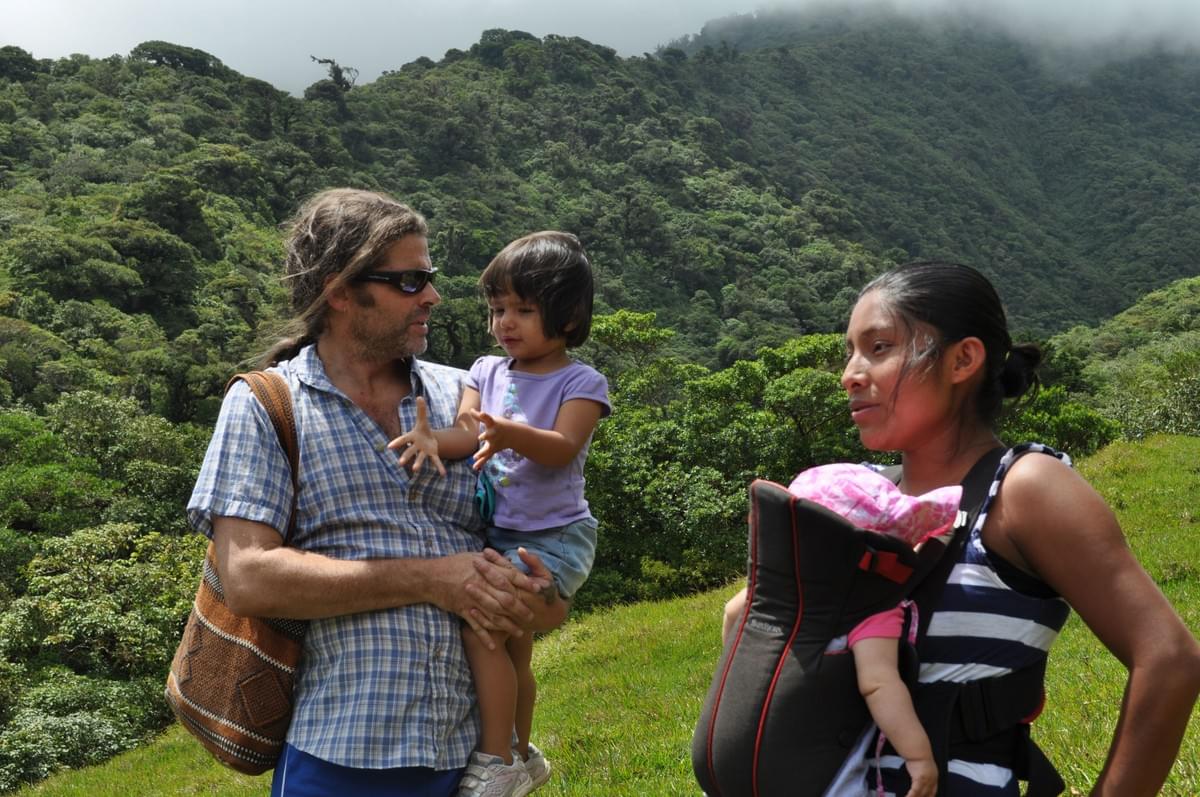
In 1997, he joined an NGO in the remote Bribri village of Yorkín, on the Costa Rica–Panama border. For more than a year, he lived within the community, learned Spanish and even some Bribri language from the villagers, and adapted to life in the rainforest. It was a life-changing experience.
During that time, Conall and his mother, Aisling, began to envision a new kind of gallery in San José — one that would give Indigenous art a permanent and visible place in Costa Rica’s capital. Conall began traveling extensively through Costa Rica, Panama, Nicaragua, and Honduras, meeting artists, documenting traditions, and collecting works. He focused on two questions: Who is still creating in the traditional way? And how can their work be meaningfully and respectfully shared with the world?
Those journeys led to the founding of Galería Namu in 1998. From the start, the gallery offered museum-quality Indigenous and national folk art, sold directly from the artists to an international public. It also served as a space for cultural exchange, hosting visitors and arranging respectful trips to indigenous communities interested in eco-ethno tourism.
By 2005, Conall was working full time in the gallery, building lasting relationships with artists from the indigenous Bribri and Cabécar of Costa Rica, the Wounaan and Emberá of Panama, the Miskitu and Pech of Honduras, among others. Over the years, Galería Namu became known not just as a shop, but as a trusted source of authentic art and a repository of the stories behind it.
When the physical gallery closed in 2020 due to the pandemic, the mission didn’t end — it evolved. Today, with the relaunch of galerianamu.com, the gallery’s work continues online. Now, anyone in the world can explore and purchase original works from southern Central America’s indigenous and folk artists, with the same commitment to authenticity and respect that has guided Conall from the beginning.
For him, this work is more than a business. It’s a lifelong commitment to cultural preservation, economic opportunity, and cross-cultural understanding. Every piece tells a story. Every artist represents a living tradition.
Conall lives in Costa Rica’s Central Valley with his wife and two daughters. When he’s not sourcing art or collaborating with artists, he enjoys wood carving, painting, and sketching — keeping his own creative spirit alive.
“Art is a thread,” Conall says. “It connects people across time and distance. My job is to help that thread travel as far as it can.”
