Home
Shop Gallery
All Categories
Gallery Story
Special Orders
Ethnographic Map
Contact
…
Home
Shop Gallery
All Categories
Gallery Story
Special Orders
Ethnographic Map
Contact
Home
Shop Gallery
All Categories
Gallery Story
Special Orders
Ethnographic Map
Contact
…
Home
Shop Gallery
All Categories
Gallery Story
Special Orders
Ethnographic Map
Contact
All Categories - Galeria Namu
All
Brunka Masks & Mask Arts
Embera/Wounaan Basketwork
Embera/Wounaan Tagua Art
Miscellaneous Tribal Arts
Pre-Columbian Costa Rica
Selected Costa Rican Folk Art
“Cacique” Painting, Anyuli Mena
Code: MITA031 Size: 14” x 24” (30.5 cm x 61 cm) Powerful contemporary canvas by young Huetar artist, Anyuli Mena, from Costa Rica's Quitirrisi/Zapaton Reservation. This striking acrylic painting confronts the complex intersection of indigenous identity and modern commercial appropriation through bold social commentary that defines the Contemporary Native Arts movement. Mena's fearless composition features an ancestral Huetar cacique (chieftain) amid flames of cultural tension - addressing how indigenous imagery has been commercialized without community consent (and a reflection on community challenges with addiction). The fiery palette and dramatic symbolism reflect both ancestral spiritual power and contemporary indigenous struggles for cultural sovereignty. This museum-quality piece represents the emerging voice of young indigenous artists who refuse to remain silent about cultural exploitation. Mena, whose work ranges from tender maternal themes to fierce ancestral deities, establishes herself as a significant voice in Central American contemporary indigenous expression.
'Xaman' - El Toro
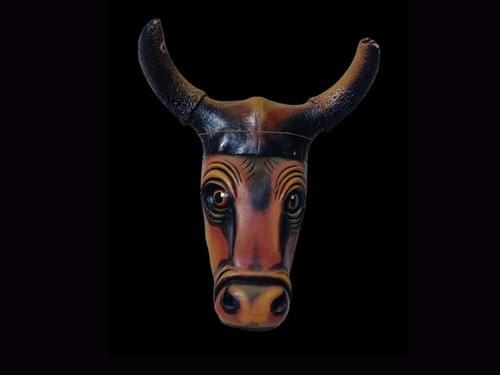
Code: ITOR001 Size: 23" x 26" (59 x 68 cms) 'Xaman' (el toro) personage is a key figure in the 'danza/juego de los diablitos' celebrated by the Brunka tribal community annually, since early colonial times. This important 3 day tribal cultural event takes place in their respective villages of Boruca and Rey Curre in southern Costa Rica. This single and imposing character in this indigenous cultural tradition represents - incarnated in the 'xaman'-bull - an antagonist figure. He is the motif of the invading , rapacious colonizer from across the ocean who does battle with waves of 'kagbru rojk' (the "diablitos") who represent the defending and resistant ancestors of the Brunka people - chieftains, warriors, shamans and mystical entities all do battle against the disruptive 'sikua' (foreigner) in the figure of 'xaman'(the bull) This is a faithful reproduction, at scale (with real horns), of the actual toro/bull mask of Boruca used in ceremony (the actual worn mask is never for sale, as opposed to the used 'diablitos' masks - some of which Namu can acquire).
Eco-diablo Mask - Wild Boar Transformation
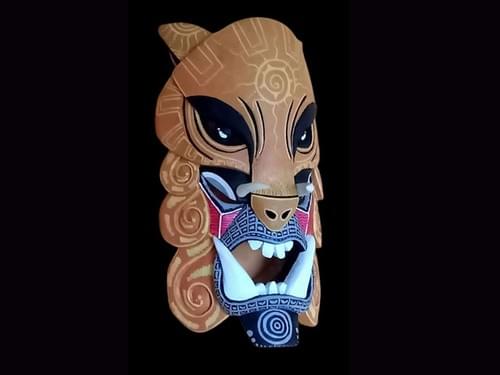
Code: IEDM006 Size: 18" tall/9 ¾”wide (46 x 25 cms) Carved and painted balsa wood mask, signed by the mask maker, Alberto Leiva of Boruca village. This mask type is a transformation, or 'alter-ego' mask. In the shamanic world-view, a shaman, or warrior, would have their own nagual popularly known as totem animal. In this case, the traditional Brunka tribal mask used in ceremony, known as the 'diablitos', are in fact representations of the Brunka people themselves (both in the past and in the present) in their centuries-old conflict with 'sikua' (non-aboriginal peoples) society and pressures - dedicated to territorial protection and the defense of their traditional lifeways.
Ecological Mask Arts = 'Onca Pantera' Homage
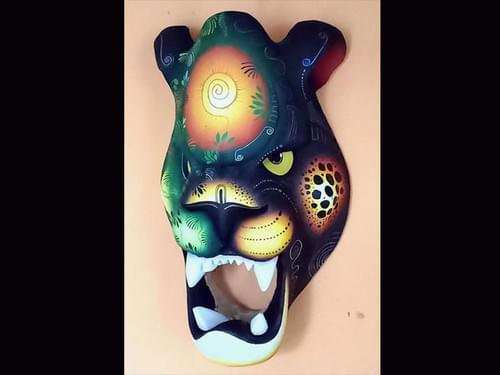
Code: IEMA007 18" tall x 9 ¾” wide (46 x 25 cms) A striking homage to 'onca pantera' - the scientific name for the spotted jaguar/black panther. These two feline types are the exact same species - the black panther possessing a genetic mutation giving it black fur. In Brunka cosmology and myth, this, the mightiest of wild cats, are the punishers of those who break tribal taboo in Brunka tradition. A central symbol of the sun on the mask's forehead symbolizes the spotted jaguar being represented by our astro (while the black panther symbolizes nighttime, the nocturnal realm). Artist: Hermes Morales
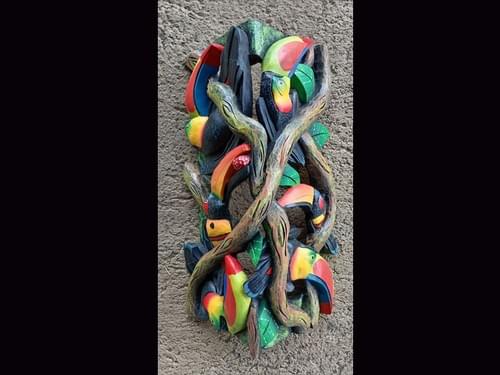
Ecological Mask Arts - Toucan and Toucanet Study
Code: IEMA008 21" tall x 9 ¾”wide (53.5 x 25 cms) In the Brunka tribe's mask arts (contemporary expression), it provides the mask maker free rein to explore his artform outside of the more traditional format seen in the typical, traditional 'diablito' mask used in their venerable 'danza de los diablitos'. The so-called 'ecological' mask type - the form of which is somewhat reminiscent of a face mask to be worn - usually features studies of certain flora and fauna from Brunka territory, sometimes ancestral motifs and objects, such as petroglyphs, or gold accoutrements of the elite, are included in the composition. Artist: Roy Lazaro
Flora and Fauna Design - Tropical Rainforest SOLD
Code: IEWV010 Size: 4 1/1" x 6 1/4" (11 x 16 cms Museum quality traditional basketwork created by two related tribes of the Darien region between Panama and Colombia, the Embera and Wounaan. These women weavers are making, arguably, the finest autochthonous baskets in the world. These impressive rainforest baskets are made by virtue of two key elements: the endemic, wild palm tree species that provide the young fronds that are split and are the basic structure of the baskets, and of course the ancestral knowledge of these women of the Darien region expressed in the dyes obtained from their surroundings and the complex stitching techniques employed since time immemorial. This particular beauty represents the apex of Wounaan basket making. Almost narrative and yet abstracted at the same time, this flora and fauna-inspired design is sublime with a geometric finishing flourish around the lip. Like most of these indigenous Darien rainforest baskets, the underside of the piece features a beautiful design resolution, a kaleidoscopic mandala, or some motif, as the hibiscus flower represented on the base of this piece.
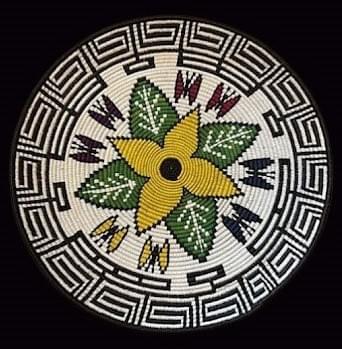
Large Plates/Disks - Geometrics and Butterflies
Code: IEWP011 Size: 20" (51 cms) diameter These two aboriginal groups are residents of the incredibly dense forest and abundant biodiversity found in the Darien region of Panama. Women basket weavers of the indigenous Embera and Wounaan are creators of the, arguably, finest traditional baskets in the world. This example of such stunning design and technique is a large woven plate (perfect artwork for wall display) with a dazzling 'mandala' consisting of tropical rainforest foliage and butterflies swirling within traditional geometric edge ring. The raw materials employed (split, dried and naturally dyed wild 'chunga' and 'naguala' palm fronds) and the weaving technique are offshoots of the traditional indigenous 'hosig di' baskets of the Darien, Panama.
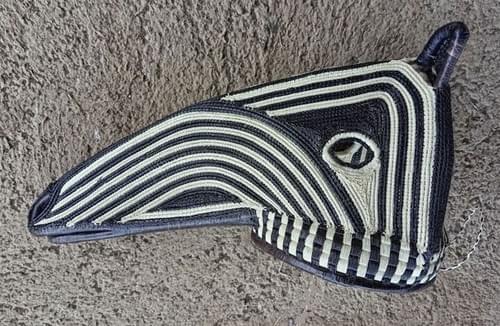
Woven Embera Masks - Anteater
Code: IEWM013 Size: 14” long x 8”wide (36 x 20 cms) Said to be inspired by the carved wooden masks and effigies of local fauna and forest spirits fashioned by their 'jaibana' (traditional medicine men) inside the healing enclosure, Embera women - whose media is weaving, not wood carving - are creating these wonderfully inspired forest beings. Some are obvious what animals they depict (as this piece is: a rather stylized anteater), while other masks are not as obvious regarding the precise mammalian, or avian type. Then some of these masks seem to be altogether fantastical creatures of tribal myth, or artisan’s imagination. The raw materials employed (split, dried and naturally dyed wild 'chunga' and 'naguala' palm fronds) and the weaving technique are offshoots of the traditional indigenous 'hosig di' baskets of the Darien, Panama.
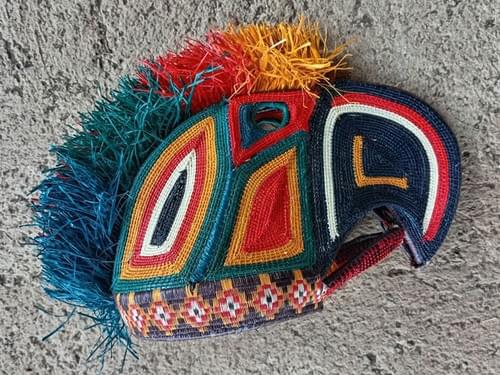
Woven Embera Mask - Miffed Crest-up Parrot
Code: IEWM014 Size: 12 1/2” long x 8”wide (32 x 20 cms) Said to be inspired by the carved wooden masks and effigies of local fauna and forest spirits fashioned by their 'jaibana' (traditional medicine men) inside the healing enclosure, Embera women - whose media is weaving, not wood carving - are creating these wonderfully inspired forest beings. Some are obvious what animals they depict (as this piece is: a parrot whose crest is up showing some strong emotion as they do naturally!), while other masks are not as obvious regarding the precise mammalian, or avian type. Then some of these masks seem to be altogether fantastical creatures of myth, or artisan’s imagination. The raw materials employed (split, dried and naturally dyed wild 'chunga' and 'naguala' palm fronds) and the weaving technique are offshoots of the traditional indigenous 'hosig di' baskets of the Darien, Panama.
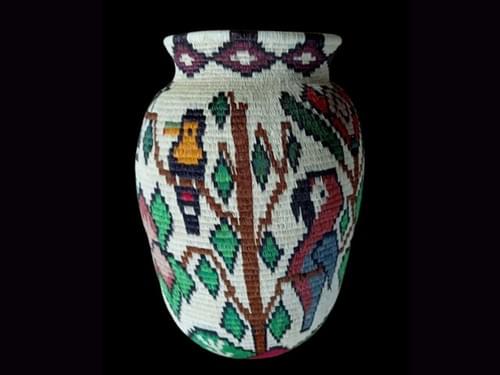
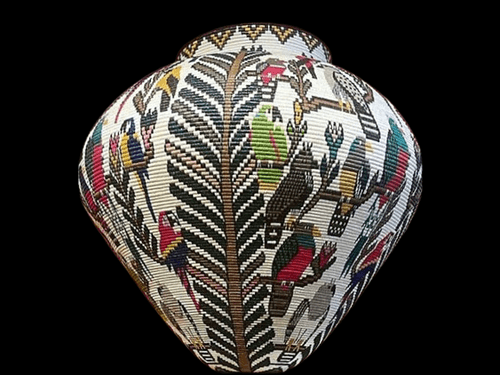
Oversize Basket - Flora and Fauna Rainforest Design
Code: IEWV016 Size: 33 3/4" (86 cms) tall This particular beauty represents the apex of Wounaan basket making: the monster, oversized scale (standing at nearly 3 feet tall!) combined with the intensity of the tapestry-like rainforest composition is visually overwhelming. This masterpiece indigenous basket took the artist more than three years to complete (just the weaving alone, not to mention the preparation of the natural raw materials from her rainforest surroundings for her piece). Almost narrative and yet abstracted at the same time, this flora and fauna-inspired design is sublime with a pleasing geometric finishing flourish around the lip. Like most of these indigenous Darien rainforest baskets, the underside of the piece features a beautiful design resolution: a kaleidoscopic mandala, or some culminating motif (decorating tip: these basket vessels are best displayed on a glass shelf in order to appreciate the incredible work on the underside! These impressive rainforest baskets are made by virtue of two key elements: the endemic, wild palm tree species that provide the young fronds that are split and are the basic structure of the baskets, plus ancestral knowledge.
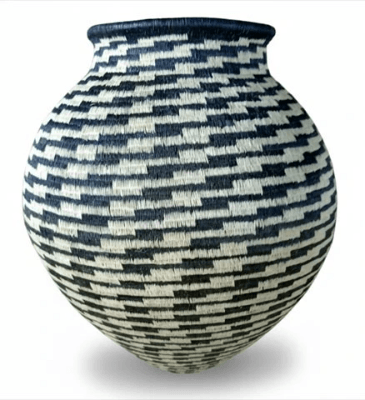
Basket Vessels - Geometric Spiral SOLD
Code: IEWV009 Size: 6 3/4" x 7 1/2" (17 x 19cms) At this level, this beautiful marvel of technique and design represents the apex of Wounaan basket making - an activity as old as ancestral memory itself. Like most of these indigenous Darien rainforest baskets, the underside of the piece features a beautiful design resolution: a kaleidoscopic mandala, on the base of the piece (decorating tip: these basket vessels are best displayed on a glass shelf in order to appreciate the incredible work on the underside!). The perfection in the tessellation of this geometric swirl design is mind boggling! From 2 related tribes of the Darien region between Panama and Colombia, the Embera and Wounaan, these women weavers are making, arguably, the finest traditional baskets in the world. These impressive rainforest baskets are made by virtue of two key elements: the endemic, wild palm tree species that provide the young fronds that are split and are the basic structure of the baskets and of course the ancestral knowledge of the Native women of the Darien region expressed in the dyes obtained from their surroundings and the complex stitching techniques employed since time immemorial.
Tagua Sculpture - Howler Monkey Mother with Young
Code: ITNM018 Size: 4" (10 cms) tall Carving is traditionally a male activity among the indigenous Embera and Wounaan of the Darien region of eastern Panama. Historically and up to present times, highly skilled wood carvers among these two Native peoples have been fashioning elegant dugout canoes and shamanic ritual implements (carved staffs) in local rainforest hardwoods. Since the 70's, these carvers turned their attention to carving the potato-sized tagua ("ivory") nut on the suggestion, as it's been anecdotally told - by a biologist working and investigating in the Darien forest years ago. As carving was already a highly developed skill among these two tribes ancestrally, these carvers excelled in creating wonderful (and often, very naturally rendered) figurines of local flora and fauna endemic to their territory. This remarkable rendering of a howler monkey mother and young in a tree eating fruit is so precious, capturing so naturally these animals and their natural poses among their forest surroundings. All pieces are signed by the artist
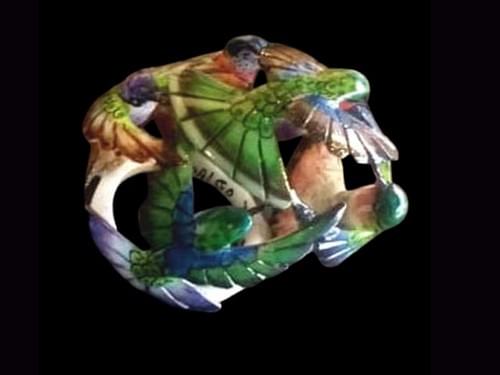
Tagua Sculpture - Hummingbird Ball
Code: ITNB021 Size: 3 1/4" (8.25 cm) diameter What a tour de force - the specific talent and fame of this Wounaan carver, Idalgo Piraza, is his able to carve in one single tagua nut, multiple animals. This is his 'hummingbird ball'. Carving is traditionally a male activity among the indigenous Embera and Wounaan of the Darien region of eastern Panama. Historically and up to present times, highly skilled wood carvers among these two Native peoples have been fashioning elegant dugout canoes and shamanic ritual implements (carved staffs) in local rainforest hardwoods. Since the 60's, these carvers turned their attention to carving the potato-sized tagua ("ivory") nut on the suggestion, as it's been anecdotally told - by a biologist working and investigating in the Darien forest years ago. As carving was already a highly developed skill among these two tribes ancestrally, these carvers excelled in creating wonderful (and often, very naturally rendered) figurines in tagua nut of local flora and fauna endemic to their territory. All pieces are signed by the artist
Tagua Sculpture - Red-eyed Green Tree frog and Heliconia
Code: ITNR023 Size: 3 3/4" (9.5 cms) tall This small, intricate sculpture is a realistic rendering of a red-eyed green tree frog resting upon a heliconia plant. The artist consciously has left the natural tagua nut base exposed alongside the remarkable, naturalistic sculpted rendering of this amphibian and forest plant. The coloured regions is achieved with india inks and fine quills. Carving is traditionally a male activity among the indigenous Embera and Wounaan of the Darien region of eastern Panama. Historically and up to present times, highly skilled wood carvers among these two Native peoples have been fashioning elegant dugout canoes and shamanic ritual implements (carved staffs) in local rainforest hardwoods. Since the 60's, these carvers turned their attention to carving the potato-sized tagua ("ivory") nut on the suggestion, as it's been anecdotally told - by a biologist working and investigating in the Darien forest years ago. As carving was already a highly developed skill among these two tribes ancestrally, these carvers excelled in creating wonderful (and often, very naturally rendered) figurines in the tagua nut of local flora and fauna endemic to their territory.
Tagua Sculpture - Swallow-tail Butterfly
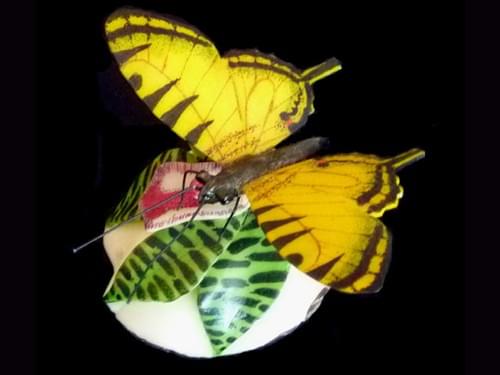
Code: ITNR025 Size: 4" (10 cms) long This hand carved and inked tagua nut sculpture is so elegant (and naturally posed on the blossom!). The composition features the sublime 'swallow-tail' butterfly, of which exist many sub-species. The coloured regions are achieved with india inks and fine quills. Carving is traditionally a male activity among the indigenous Embera and Wounaan of the Darien region of eastern Panama. Historically and up to present times, highly skilled wood carvers among these two Native peoples have been fashioning elegant dugout canoes and shamanic ritual implements (carved staffs) in local rainforest hardwoods. Since the 60's, these carvers turned their attention to carving the potato-sized tagua ("ivory") nut on the suggestion, as it's been anecdotally told - by a biologist working and investigating in the Darien forest years ago. As carving was already a highly developed skill among these two tribes ancestrally, these carvers excelled in creating wonderful (and often, very naturally rendered) figurines in the tagua nut of local flora and fauna endemic to their territory. All pieces are signed by the artist.
Tagua Sculpture - Sailfish
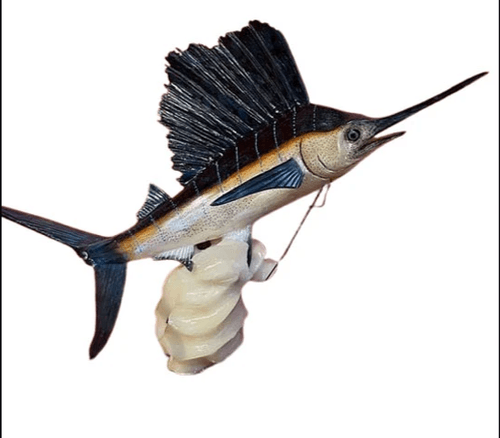
Code: ITMA026 Size: 6 1/2" x 5 ½” (17 x 14 cms) Carving is traditionally a male activity among the indigenous Embera and Wounaan of the Darien region of eastern Panama. Historically and up to present times, highly skilled wood carvers among these two Native peoples have been fashioning elegant dugout canoes and shamanic ritual implements (carved staffs) in local rainforest hardwoods. Since the 60's, these carvers turned their attention to carving the potato-sized tagua ("ivory") nut on the suggestion, as it's been anecdotally told - by a biologist working and investigating in the Darien forest years ago. As carving was already a highly developed skill among these two tribes ancestrally, these carvers excelled in creating wonderful (and often, very naturally rendered) figurines in the tagua nut of local flora and fauna endemic to their territory. This particular sculpture - a larger composition requiring several tagua nuts - is a breaching sailfish. This piece's realism is remarkable and the artist gave the sculpture a handsome 'cocobolo' (tropical rosewood) base. Colouring is achieved with india inks and fine quills. All pieces signed by the artist.
Brunka tribe: 'Jicara' mammals of southern Costa Rica - Anteater
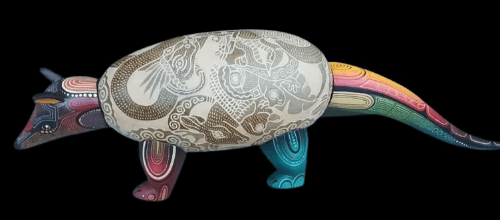
Code: MITA028 Size: 25 3/4" long x 6 3/4”tall (65 x 17 cms) Only two (women) artists create these extraordinary mammal figures in the world. These collectible figures of endemic Costa Rican mammals are particularly so, not only for their uniqueness, but also due to the fact that only 2 individuals create them, the production is slow and only one, maybe two, are made at once. Cecilia Morales, the artisan who made this anteater figure has been, for most of her productive life, a maker of very elaborately decorated jicaras (the gourd-like, dried fruit shell of a local tree ancestrally used for liquid containers). The finely patterned coloured members are carved wood parts (then mounted into the 'jicara' body) . The 'jicara' itself has finely detailed engraving designs in its surface (this is the traditional way the local tribes embellish the surface of these natural water containers.
Brunka tribe: 'A Homage to Our Ancestors' - Acrylic on canvas, Melvin Gonzalez,
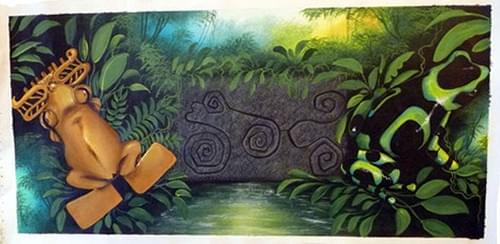
Code: MITA030 Size: 18 x 28" (46 x 71.5 cms) A powerful painted theme by indigenous artist, Melvin Gonzalez. Gonzalez is a ceremonial participant in the Brunka tribe's venerable 'danza/juego de los diablitos' and is a celebrated mask maker and mural painter. This acrylic on canvas composition is an evocative study of a celebrated poison dart frog species of their territory. First as a realistically rendered natural history study of this frog which then dialogues in the same composition with ancestral depictions of this amphibian: in petroglyph and a cast-gold amulet both from pre-European times.
Chorotega indigenous group: Pre-Columbian Pottery reproduction – Seated Nicoya Noblewoman
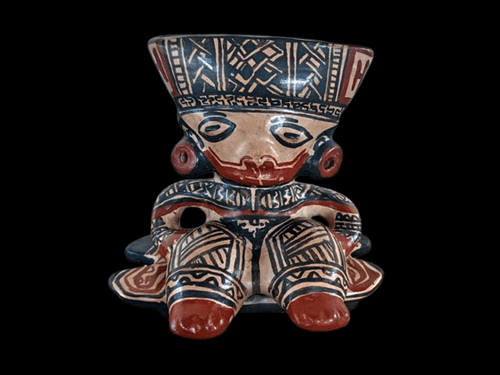
Code: MITA029 Size: 8 ¾” x 9 ¼” (22.5 x 24 cms) The traditional Chorotega potters from the northwest regions of Guanacaste and Nicoya Peninsula, Costa Rica, are descended from the famous pre-European potters of this culturally rich region. The first Spanish explorers to pass through this territory were astounded at the sublime artistry and material techniques employed by of the artisans of this area which archeologists have defined as the Gran Nicoya Region famous for its pottery, jade work and volcanic stone carving before the arrival of Europeans by mid-1500’s. This figure represents a Nicoya noblewoman – fully tattooed with large ear spools showing her rank – seated upon her stone throne. Today’s Chorotega potters from the principal villages of Guaitil and San Vicent, where pottery is an important activity, are both reproducing their ancestral Pre-Columbian designs as well as creating a synthesis of ancestral with more contemporary forms adding a continuing vitality to this ancient activity. Chorotega pottery is coil construction, kiln-fired and local clay slips decorate the surface – the exact same techniques employed by their ancestors to create this pottery.
'Native Madonna' - Anyuli Mena (Huetar tribe)
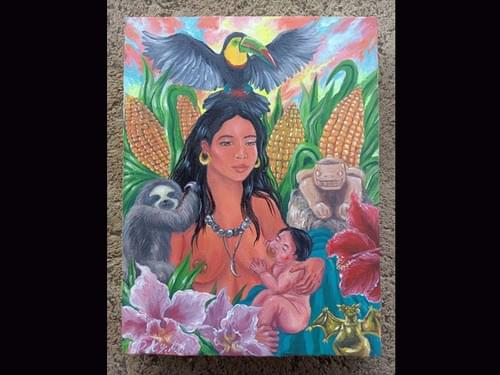
Code: MITA032 Size: 18 x 28" This tender, yet powerful, acrylic on canvas composition is an evocative study of Native motherhood. Mena is a young, up and coming painter from the Huetar communities of the Central Valley of Costa Rica. This painting depicts a mother and her child surrounded by the strength of the ancestors, local animals and traditional foodstuffs.
Show more
Authentic Indigenous & Folk Arts of Costa Rica / Southern Central America
Est. 1998
Cookie Use
We use cookies to ensure a smooth browsing experience. By continuing we assume you accept the use of cookies.
Accept
Learn More