Home
Shop Gallery
All Categories
Gallery Story
Special Orders
Ethnographic Map
Contact
…
Home
Shop Gallery
All Categories
Gallery Story
Special Orders
Ethnographic Map
Contact
Home
Shop Gallery
All Categories
Gallery Story
Special Orders
Ethnographic Map
Contact
…
Home
Shop Gallery
All Categories
Gallery Story
Special Orders
Ethnographic Map
Contact
Miscellaneous Tribal Arts - Galeria Namu
All
Brunka Masks & Mask Arts
Embera/Wounaan Basketwork
Embera/Wounaan Tagua Art
Miscellaneous Tribal Arts
Pre-Columbian Costa Rica
Selected Costa Rican Folk Art
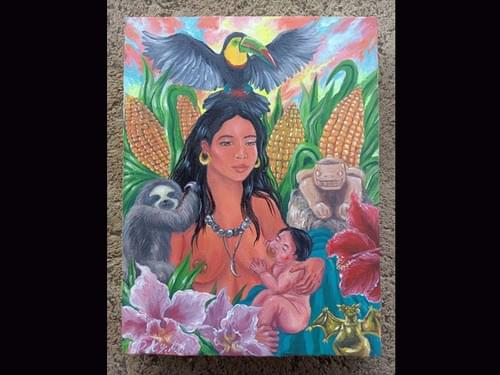
'Native Madonna' - Anyuli Mena (Huetar tribe)
Code: MITA032 Size: 18 x 28" This tender, yet powerful, acrylic on canvas composition is an evocative study of Native motherhood. Mena is a young, up and coming painter from the Huetar communities of the Central Valley of Costa Rica. This painting depicts a mother and her child surrounded by the strength of the ancestors, local animals and traditional foodstuffs.
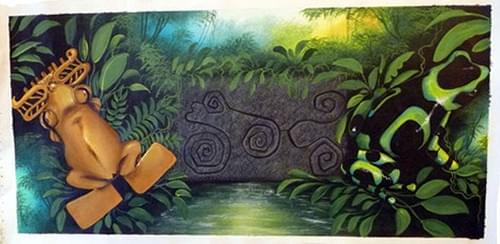
Brunka tribe: 'A Homage to Our Ancestors' - Acrylic on canvas, Melvin Gonzalez,
Code: MITA030 Size: 18 x 28" (46 x 71.5 cms) A powerful painted theme by indigenous artist, Melvin Gonzalez. Gonzalez is a ceremonial participant in the Brunka tribe's venerable 'danza/juego de los diablitos' and is a celebrated mask maker and mural painter. This acrylic on canvas composition is an evocative study of a celebrated poison dart frog species of their territory. First as a realistically rendered natural history study of this frog which then dialogues in the same composition with ancestral depictions of this amphibian: in petroglyph and a cast-gold amulet both from pre-European times.
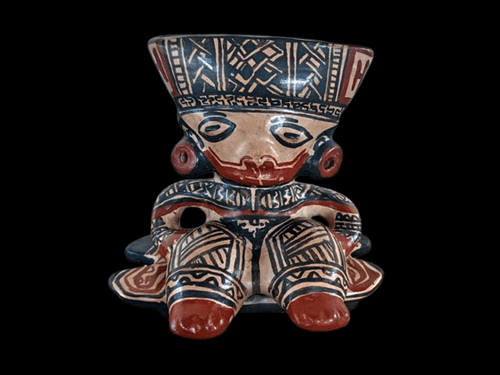
Chorotega indigenous group: Pre-Columbian Pottery reproduction – Seated Nicoya Noblewoman
Code: MITA029 Size: 8 ¾” x 9 ¼” (22.5 x 24 cms) The traditional Chorotega potters from the northwest regions of Guanacaste and Nicoya Peninsula, Costa Rica, are descended from the famous pre-European potters of this culturally rich region. The first Spanish explorers to pass through this territory were astounded at the sublime artistry and material techniques employed by of the artisans of this area which archeologists have defined as the Gran Nicoya Region famous for its pottery, jade work and volcanic stone carving before the arrival of Europeans by mid-1500’s. This figure represents a Nicoya noblewoman – fully tattooed with large ear spools showing her rank – seated upon her stone throne. Today’s Chorotega potters from the principal villages of Guaitil and San Vicent, where pottery is an important activity, are both reproducing their ancestral Pre-Columbian designs as well as creating a synthesis of ancestral with more contemporary forms adding a continuing vitality to this ancient activity. Chorotega pottery is coil construction, kiln-fired and local clay slips decorate the surface – the exact same techniques employed by their ancestors to create this pottery.
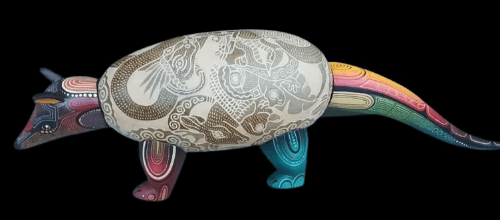
Brunka tribe: 'Jicara' mammals of southern Costa Rica - Anteater
Code: MITA028 Size: 25 3/4" long x 6 3/4”tall (65 x 17 cms) Only two (women) artists create these extraordinary mammal figures in the world. These collectible figures of endemic Costa Rican mammals are particularly so, not only for their uniqueness, but also due to the fact that only 2 individuals create them, the production is slow and only one, maybe two, are made at once. Cecilia Morales, the artisan who made this anteater figure has been, for most of her productive life, a maker of very elaborately decorated jicaras (the gourd-like, dried fruit shell of a local tree ancestrally used for liquid containers). The finely patterned coloured members are carved wood parts (then mounted into the 'jicara' body) . The 'jicara' itself has finely detailed engraving designs in its surface (this is the traditional way the local tribes embellish the surface of these natural water containers.
“Cacique” Painting, Anyuli Mena
Code: MITA031 Size: 14” x 24” (30.5 cm x 61 cm) Powerful contemporary canvas by young Huetar artist, Anyuli Mena, from Costa Rica's Quitirrisi/Zapaton Reservation. This striking acrylic painting confronts the complex intersection of indigenous identity and modern commercial appropriation through bold social commentary that defines the Contemporary Native Arts movement. Mena's fearless composition features an ancestral Huetar cacique (chieftain) amid flames of cultural tension - addressing how indigenous imagery has been commercialized without community consent (and a reflection on community challenges with addiction). The fiery palette and dramatic symbolism reflect both ancestral spiritual power and contemporary indigenous struggles for cultural sovereignty. This museum-quality piece represents the emerging voice of young indigenous artists who refuse to remain silent about cultural exploitation. Mena, whose work ranges from tender maternal themes to fierce ancestral deities, establishes herself as a significant voice in Central American contemporary indigenous expression.
Authentic Indigenous & Folk Arts of Costa Rica / Southern Central America
Est. 1998
Cookie Use
We use cookies to ensure a smooth browsing experience. By continuing we assume you accept the use of cookies.
Accept
Learn More